
I have been monitoring the UK power generation for about 5 years using Elexon 1 hour snapshots . On June 1st Elexon introduced their equivalent power monitoring system and stopped supporting the snapshot data interface that I have been using for the last 9 years. Therefore it makes no sense for me to continue my old version, so instead I will in future access their data directly However my system will still be able to monitor the political efforts to”transition” to low carbon power sources (Wind & Solar) which is once again being hyped up as an election issue. My latest analysis with the bold interface again demonstrates the underlying problems of relying on intermittent power sources (you can’t).
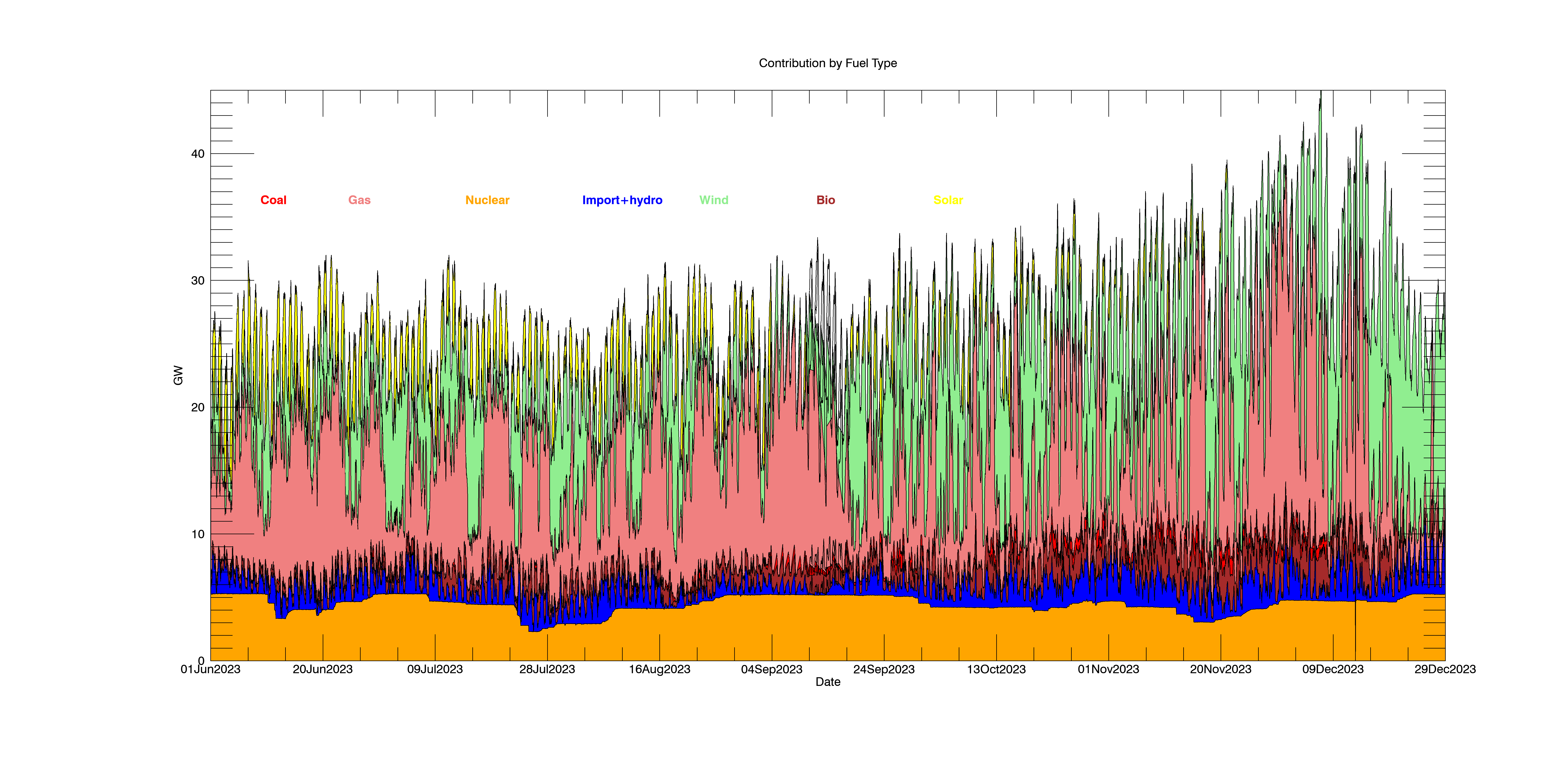
Power generation by fuel type up to January 2024
Winter 2023 suffered several wind deserts, while demand has actually increased compared to a year ago. I suspect this is probably due to the rapid increase in electric car usage and perhaps also increased use of heat pumps. There is unfortunately no such thing as a free lunch !
The severe anti-correlation of gas generation to wind power to balance the grid is shown below. Even coal generation was needed a couple of times to help meet demand.

Comparison of Wind Power generation with Gas generation. You can see an almost perfect anti-correlation. Natural Gas is an essential fuel for the UK.
All main political parties pay lip service to the “Net Zero” energy agenda. Achieving net zero was even put into UK law by Ed Miliband with his Climate Change Act. The problem though is that achieving such a goal is currently impossible! Furthermore this conclusion will not change even if we were to double current Wind and Solar generation. Engineers should determine energy policy – not politicians! The only proven way to cut carbon emissions to zero is to invest in more nuclear power like France, but no doubt the Green Party and others will oppose that too. So currently it also makes far more sense to continue extracting our own North Sea Gas instead of importing liquified gas with a much larger carbon footprint ! As a result energy costs will continue to rise mainly to satisfy short term political posturing, and there is not a hope in hell Net Zero can be reached based on renewables alone.


This is a good and straightforward presentation on the fundamental issue of the capacity required to back up wind as it fails in winter. The EV and Heat Pump expansion will blow the issue up escalating domestic costs for heating and killing off the elderly and poor. Yet here in Scotland we keep hearing of the necessity and how rosey the green future is while the SNP have demolished all coal power plant, instead of mothballing them for emergency use, and our nuclear is all but over. Scotland will show the path to failure when our last nuclear unit has a temporary shut down and gas suffers a cold day snap….. lights off over and out.
I concluded the same thing based on Northeast US data https://pragmaticenvironmentalistofnewyork.blog/2024/06/03/wind-and-solar-resource-availability-fatal-flaw/
I believe it is the case everywhere. Ignoring nuclear while trying to reduce CO2 will not work.
There are a number of things which could trip up this new government and possibly see a no-confidence vote in three years or so. But the primary one would be blackouts. Even if we only have a single one, Ed Miliband will be shown all over the news, and it’s downhill from then on.
There was an interesting discussion on BBC Radio 4, for anyone that can listen in: https://www.bbc.co.uk/sounds/play/m00237z4
Thanks for the link. Yes it was an interesting discussion and sketches how a renewable grid might perhaps work, so long as consumers become part of the demand/supply if they have solar panels and EVs. However the dunkelflaute problem is sketched over. I suspect we will always need a core nuclear baseload together with standby Gas stations to avoid blackouts.
Quite, and it was Evan Davis’s last question that was the crucial one — what happens when the wind doesn’t blow and the sun doesn’t shine? It is unlikely that there will be sufficient baseload (i.e., nuclear) capacity under such circumstances, so fire-up the gas boilers (although hydrogen gets a mention without much in the way of specifics). In this respect, carbon capture also gets a mention without any real discussion of how this is going to be done. It’s almost as if no one wants to hear of any problems with supplying electrical power with wind and sun.
And another interesting link: https://www.bbc.co.uk/news/articles/c5y35qz73n8o
Curtailing the use of fossil fuels is a mistake.
I am an experienced, licensed engineer (heat transfer, thermodynamics) who has been researching climate change for about 18 years. Climate has always changed and always will. Promoting that carbon dioxide change is a significant cause of climate change, or even a significant contributor is misinformation.
Water vapor (WV) is IR active at earth temperatures, that is, water vapor is a ‘greenhouse gas’. NASA/RSS has been accurately measuring average global water vapor using satellite-based instrumentation since Jan 1988. WV trend has been increasing about 1.4 % per decade and can explain all of the climate change attributable to human activity.
Less than half of the measured WV increase is a result of planet warming. The rest is due to the increase in population and especially the increase in irrigation. I have found no evidence that the Climate Science community has figured out how to calculate WV increase from temperature increase or how to explain the measured increase in WV. Analysis and graphics showing this are made available at https://watervaporandwarming.blogspot.com The future will result in all this becoming more widely known.
Yes Water Vapour is the most important greenhouse gas and human impact has been large changing it’s distribution through irrigation and farming. Man has also changed CO2 levels also through deforestation, farming and cities. This effect is essentially ignored by the IPCC.